A carrier that appears only before a veterinary visit can become a clear signal that something unfamiliar is about to happen. Owners then face a hurried search under furniture while the appointment time approaches. A more useful plan begins well before travel: keep a suitable carrier available, let the cat investigate, and practise small steps without immediately turning every success into a car journey.
Carrier practice is about familiarity and choice. It is not a way to avoid veterinary care, and it cannot guarantee a stress-free trip. If your cat needs an appointment now, contact the practice for advice about getting there safely. For future visits, regular quiet practice can help you identify the carrier setup and handling approach that your cat finds most manageable.
Inspect the carrier before using it
Check the base, door, fastenings, handle, and ventilation. The carrier needs to be an appropriate size and design for your cat, with secure closures and no damage that could allow escape. Follow the manufacturer's instructions and weight limit. A carrier that looks intact from a distance may still have a cracked latch.
Consider practical access for the cat and the veterinary team. Some designs have removable tops or additional openings, but those features need to close securely. Ask your practice which options are suitable if handling is difficult. Avoid choosing solely by colour, novelty, or how small the carrier folds for storage.
Place it on a stable floor surface for the first sessions. Secure the door open as directed so it cannot swing unexpectedly. Add a suitable familiar washable covering if appropriate, keeping ventilation unobstructed. Remove loose loops, damaged padding, and anything the cat may chew or swallow.
Let the carrier become ordinary furniture
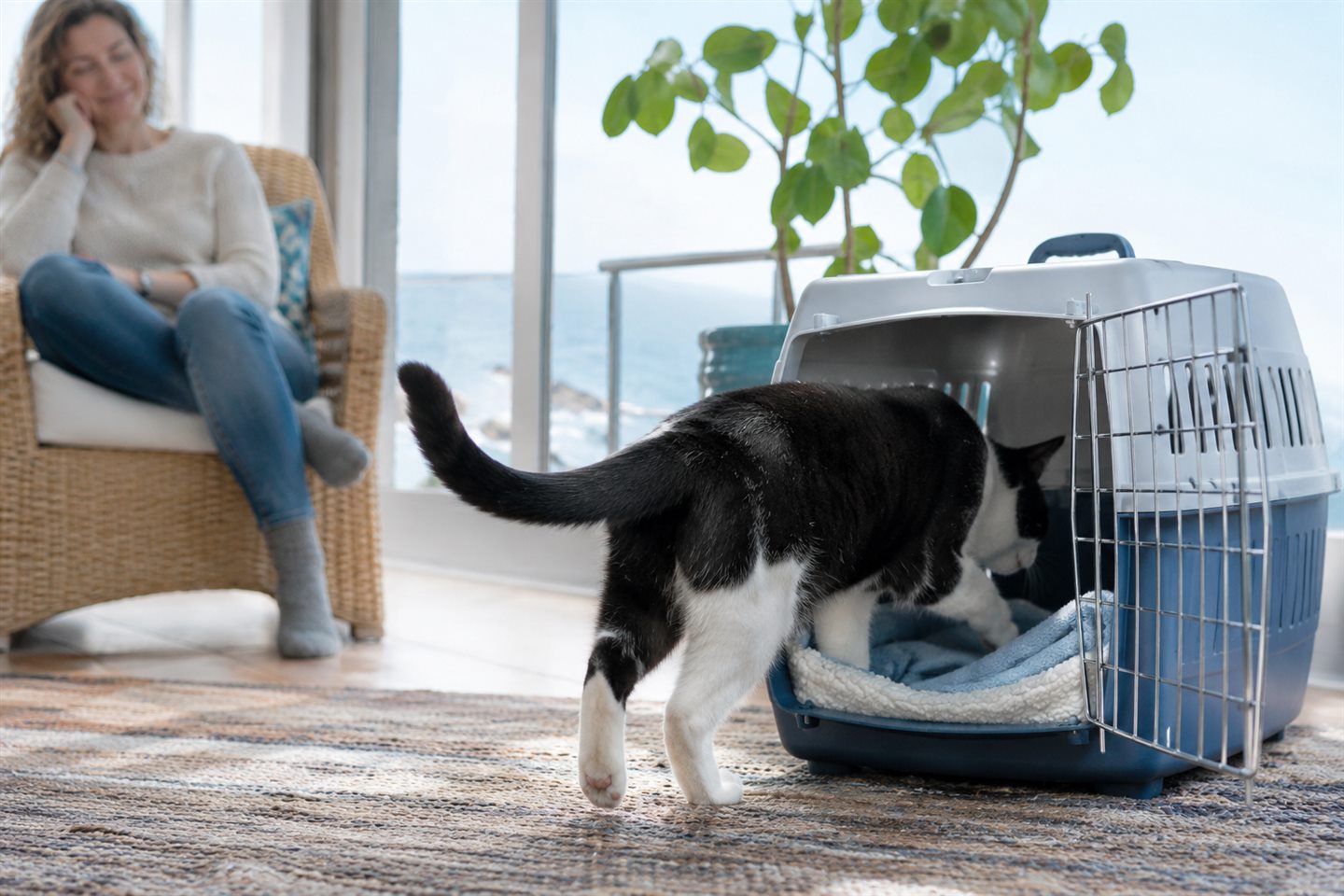
Choose a quiet location where the carrier can remain accessible without blocking a route. Do not place it immediately beside a loud appliance or another pet's food bowl. Leave the cat free to approach and retreat. Familiarity develops more easily when investigation is not followed by a hand reaching in.
Watch from a distance. Looking at the carrier, sniffing its edge, or walking past comfortably can be useful early steps. You can offer a small reward nearby if it fits the cat's normal diet. Avoid placing all essential food inside and requiring entry before the cat can eat.
If the carrier itself causes obvious avoidance, increase the distance and ask a qualified professional for help. Repeatedly moving it closer to a hiding cat is unlikely to improve the association. Keep other safe resting places available so the cat does not have to choose between the carrier and being exposed in the middle of the room.
Reward investigation in small steps
Once the cat is comfortable nearby, place an appropriate reward at the entrance. Let them collect it without reaching towards the door. Over later sessions, you may be able to place it slightly further inside. Change the distance gradually, allowing the cat to keep control over approaching and leaving.
Do not push from behind or lift the cat into the carrier as part of this exercise. That changes the task from voluntary investigation to restraint. If the cat backs away, return to an easier step later. There is no fixed number of days that every animal should need.
Keep sessions brief and stop while the cat remains comfortable. Write down the stage they accepted, such as approaching the open door or placing two paws inside. This prevents another household member assuming the cat is ready for a closed door because they once collected a treat from the entrance.
Introduce the door separately
When the cat voluntarily enters and remains comfortable, begin with very small door movements at a suitable distance. Reward calm participation and allow an easy exit. Closing the door is a separate step from entering. Do not combine it immediately with lifting, walking, and placing the carrier in a car.
Build only when the previous step is comfortable, and reopen before distress develops. If the cat becomes tense or tries to escape, reduce the difficulty. Do not repeatedly close the door to see whether they will stop protesting. A veterinarian or qualified feline behaviour professional can help design a plan for a cat with significant carrier fear.
Never leave a cat unsupervised in a training carrier with the door fastened. The session should be deliberate and short, with the caregiver able to respond. Outside practice sessions, keep the carrier configured safely according to its instructions, with the door secured open or removed if the design permits it.
Practise handling without making a journey
Once brief closure is comfortable, ask your practice about appropriate next steps for lifting and movement. Support the carrier as instructed rather than swinging it by an uncertain handle. Begin with a very small movement, return it to the stable surface, and reward comfortable participation when appropriate.
Keep the route clear before moving. Doors, stairs, loose rugs, and other animals can make carrying awkward. Plan where you will place the carrier at the destination so it is not left balancing on furniture. For vehicle travel, follow the carrier and vehicle instructions for secure positioning; do not assume every product provides crash protection.
Avoid exposing the cat to unnecessary trips simply to test progress. The next useful step may be sitting briefly in a stationary, safely parked vehicle under suitable conditions, but obtain individual guidance where needed. Never leave an animal alone in a vehicle, and do not practise in temperatures that make the space unsafe.
Prepare the real appointment early
Confirm the practice's arrival instructions and ask about quieter waiting options if your cat finds other animals difficult. Prepare paperwork, a suitable spare covering, and cleaning supplies before bringing the cat to the carrier. Last-minute searching adds noise and delay at the point when careful handling matters most.
Tell the veterinary team what the cat can currently tolerate. If prescribed medication or other preparation is recommended, follow the veterinarian's exact directions. Never give human sedatives, leftover medicines, or an unapproved calming product. A difficult trip is a reason to seek a professional plan, not to improvise treatment.
After returning home, restore the carrier to its ordinary accessible place when appropriate. Clean and dry it according to instructions, then allow the cat to approach again without an immediate journey attached. Consistency turns the carrier into a familiar object with several experiences around it, rather than a cupboard item that always predicts a hurried departure.
Keep a simple record of comfortable steps
A note on the carrier can prevent misunderstandings between caregivers. Record the last step that was comfortable and the setting in which it happened. “Entered with door secured open in the sitting room” is clearer than “carrier trained.” It makes no assumptions about closure, lifting, or travel that have not been practised.
Write down the cat's preferred approach too. They may investigate when the room is quiet or enter more readily when the carrier faces a particular direction. Share useful observations with your veterinary practice, especially if appointment-day handling remains difficult despite comfortable exploration at home.
Do not turn the record into a deadline. Some cats need a slower plan, and urgent care may require a different approach advised by the practice. Keep emergency contact information accessible independently of the training notes. Preparation is most helpful when it supports both gradual familiarisation and prompt medical care, without allowing one to delay the other when the cat needs professional attention.
Further reading
Cats Protection's carrier guidance and PDSA's advice on carriers offer background. Ask your own veterinary practice for a plan when an appointment is urgent or your cat is highly distressed.