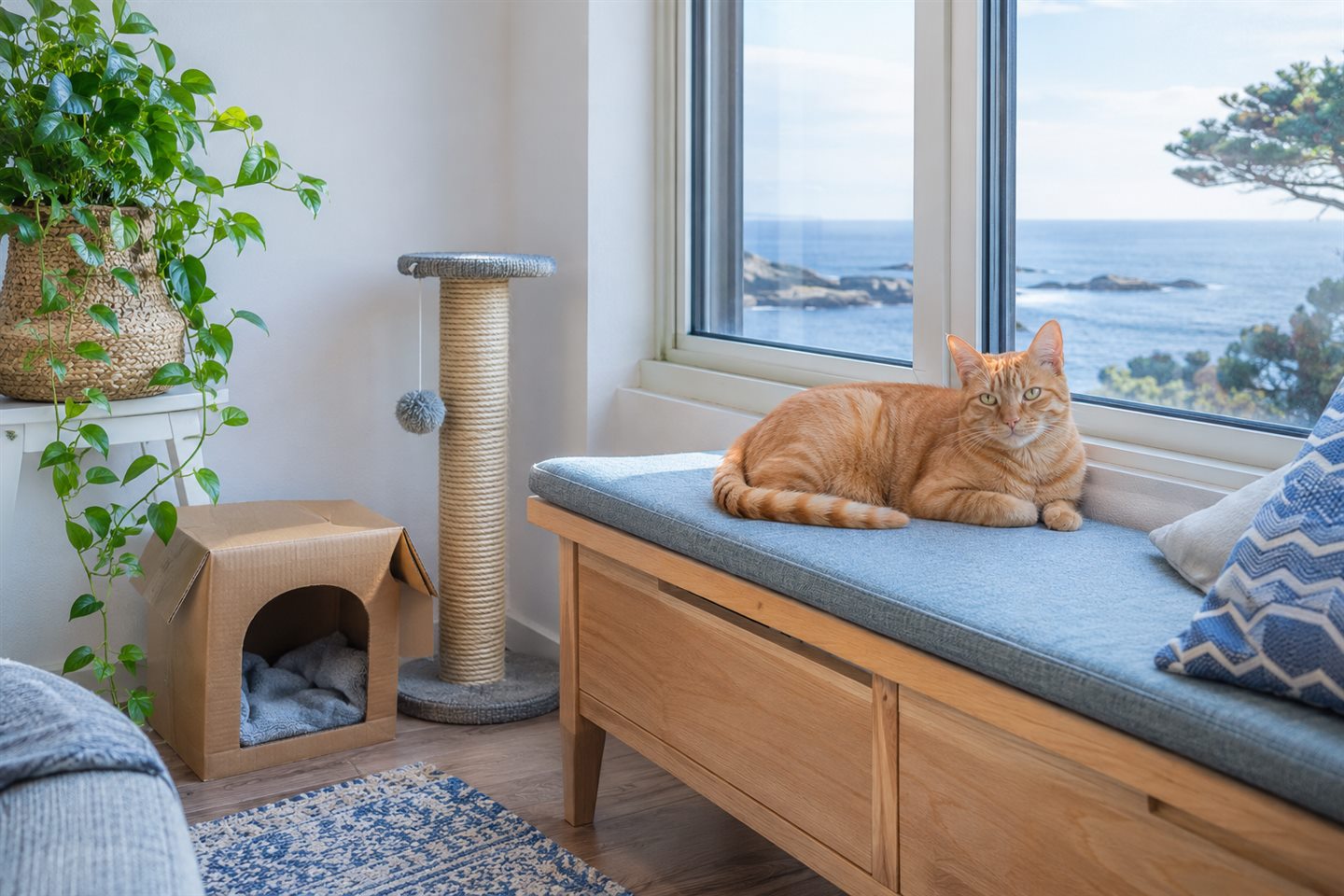
You pick up a toy, your cat watches for a moment, and then they walk away. It is easy to decide they are lazy or uninterested. Yet a play session has several moving parts: the room, the toy, the movement, the timing, and the cat's willingness to participate. Adjusting one of those details often makes more sense than buying a louder toy.
Good play leaves room for watching, waiting, catching, and stopping. It does not require a cat to leap constantly or continue after they have had enough. Think of your role as offering an interesting opportunity. Your cat supplies the pace. A few thoughtful sessions can also teach you which movements and spaces your cat prefers, making daily interaction easier for both of you.
Choose a comfortable starting point
Look at the room before inviting play. Clear fragile objects and remove obstacles from the likely path. Use a surface with reliable footing and enough space to turn. Avoid encouraging jumps towards open windows, high shelves, unstable furniture, or another animal's resting place.
Timing matters, but there is no universal schedule. Notice when your cat naturally becomes active and try a brief invitation then. Waking a sleeping cat by dangling something over their face is unlikely to create a comfortable experience. A household may find a short session before a normal meal convenient, provided this fits the cat's established care routine.
Give other animals their own space if they compete for the toy. A cat who hangs back may be yielding to a more confident companion rather than rejecting play altogether. Separate sessions can make it easier to observe each cat's preferences. Do not use a toy to draw a worried animal into close contact with another pet.
Let the toy move like something worth watching
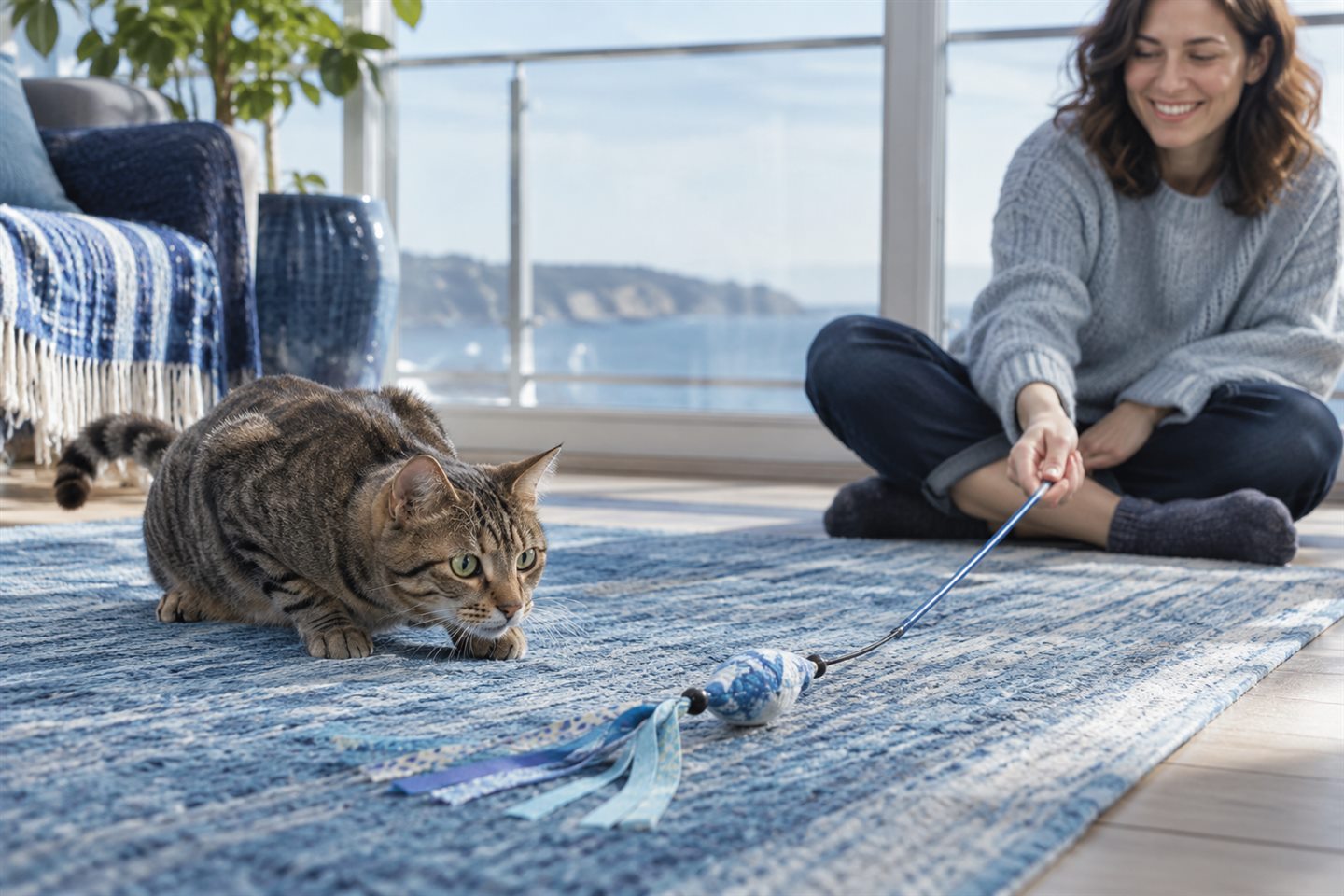
Try moving a suitable wand toy along the floor, pausing, and then letting it disappear partly behind a safe object. Keep the motion slow enough for the cat to follow. Constantly waving the toy directly at their face removes the opportunity to approach and may feel intrusive.
Watch what catches attention. Does your cat follow a low movement along the edge of a rug? Do they prefer a small hop or a long pause? Change one feature at a time. If the cat begins tracking the toy, allow that watchful phase rather than speeding up immediately to demand a pounce.
Let the cat catch the toy regularly, using an item designed for appropriate supervised play. Avoid pulling sharply against teeth or claws. Inspect the toy before and after use, particularly attachment points and small pieces. Put string and wand toys away securely when the session ends so unsupervised chewing does not become part of the game.
Build pauses into the session
Stillness is not necessarily failure. A cat may crouch, watch, change position, and wait before moving. Allow a pause and see whether interest returns. If you keep increasing speed whenever the cat stops, a manageable game can become overwhelming.
Offer an easy reset. Let the toy rest, give the cat room, and begin again with a smaller movement if they remain interested. A session can contain several short bursts with quiet intervals. There is no need to reach a fixed number of pounces or minutes. Your cat's comfort is a better guide than a timer.
If the cat leaves, let them. Following from room to room with the toy changes an invitation into pressure. Try again at another time or with a different safe toy. A sudden loss of interest across several usual activities, especially alongside appetite or mobility changes, warrants a veterinary conversation rather than a more demanding game.
Keep hands out of the game
Moving fingers under a blanket can be entertaining when a kitten is small, but it makes human skin part of the target. Use an appropriate toy that creates distance between your hand and the cat. Encourage household members to follow the same approach so the rules do not change from person to person.
If play turns towards hands or feet, become still and end the interaction calmly when you can do so safely. Avoid shouting, rough handling, or responding with faster movement. Later, offer a suitable alternative in a more manageable setting. Repeated biting or fear needs individual help from a veterinarian or a qualified feline behaviour professional.
Teach children to invite play with adult supervision and to recognise when the cat leaves. A child should not carry the cat back to the session or reach into a retreat. The shared goal is an animal who can participate willingly, with a clear option to stop and a safe distance from people's bodies.
Choose variety with a purpose
Keep a small selection of safe toys with different ways of moving. One might be suitable for floor-level chasing, another for batting independently under supervision. Introduce a change when the cat seems interested in exploring, rather than presenting several unfamiliar objects at once.
Check size, materials, and condition carefully. Loose feathers, detached bells, foam pieces, and strings can become ingestion hazards. Remove damaged toys. Avoid relying on labels such as “natural” or “cat favourite” as evidence that an item suits your animal. A cat who chews and swallows objects needs a more cautious selection and veterinary advice.
Record preferences in practical terms: low movement, quiet room, short bursts, soft toy, or a particular time of day. These observations are useful if someone else cares for the cat. They are also more informative than assuming a breed, age, or personality label tells you exactly how the animal will want to play.
Finish in a way that feels complete
As interest slows, offer an easy final catch, let the toy become still, and put it away without a sudden tug. Return to the ordinary household rhythm. Fresh water and a comfortable resting place should remain available. If play happens near mealtime, use the normal feeding plan rather than adding an unmeasured extra meal.
Take a moment to inspect the space. Did a mat slide? Did the cat hesitate at a turn? Did another animal block the exit? Small changes can improve the next session. If you notice limping, discomfort, or reluctance to jump, stop encouraging those movements and seek veterinary advice.
The best progress may be modest: a previously hesitant cat watches from closer by, catches the toy once, or chooses to return after a pause. Those are useful observations without becoming a promise that play will solve every behaviour concern. Keep offering safe, respectful interaction, and allow your cat's changing preferences to shape what happens next.
Make play easy for another caregiver
Leave the preferred toy where a caregiver can find it, together with the instruction to store it securely afterwards. Describe the motion your cat enjoys in a short sentence: slow movement beside the rug, pauses behind the chair leg, or a gentle sweep across clear floor. This is more useful than telling someone to tire the cat out.
Explain the stopping points too. If your cat usually walks to a particular bed when finished, the sitter should let that transition happen. If another pet joins, show how to create separate access without chasing either animal. Brief practical guidance helps keep the experience familiar when you are away.
Ask for observations instead of a target number of minutes. A caregiver can tell you that the cat watched, caught the toy twice, and then left comfortably. That account respects the cat's pace and gives you useful information. A fixed play quota can encourage someone to keep prompting long after the animal has chosen a quiet corner.
Further reading
Battersea's guidance on a cat-friendly home provides context for safe activity spaces and access to retreats. Play should fit within that broader environment rather than displace rest or essential resources.